Do Glucose Spikes Harm Us?
Dr. Joanna Czarnecka-Herok, PhD
Scientist & Science Communicator · Biology of Aging
If you follow nutrition podcasts or wellness news, you have likely noticed the growing buzz around Continuous Glucose Monitors or CGMs. Devices once reserved strictly for diabetes management are now being marketed to the healthy population as must-have tools for energy, longevity, and metabolic health. But stripping away the marketing hype leaves a fundamental question: is tracking everyday glucose fluctuations actually useful for someone without diabetes?
I love reading about health tech, listening to longevity podcasts and following new trends. However, deep down, a warning bell always goes off in my mind: what is real clinical evidence and what is just a marketing gimmick. I have spent my career in a lab studying how cells age and what drives disease. Years of analysing data, reading papers, and presenting at scientific conferences have taught me one key lesson: always check the source. To me, this means reading the papers myself.
So when I started wondering whether I, too, should buy a CGM, my first thought was "yes, obviously, more data is always better." But then the scientist in me said: let's see what the PubMed database actually has to say about this.
What is a CGM?
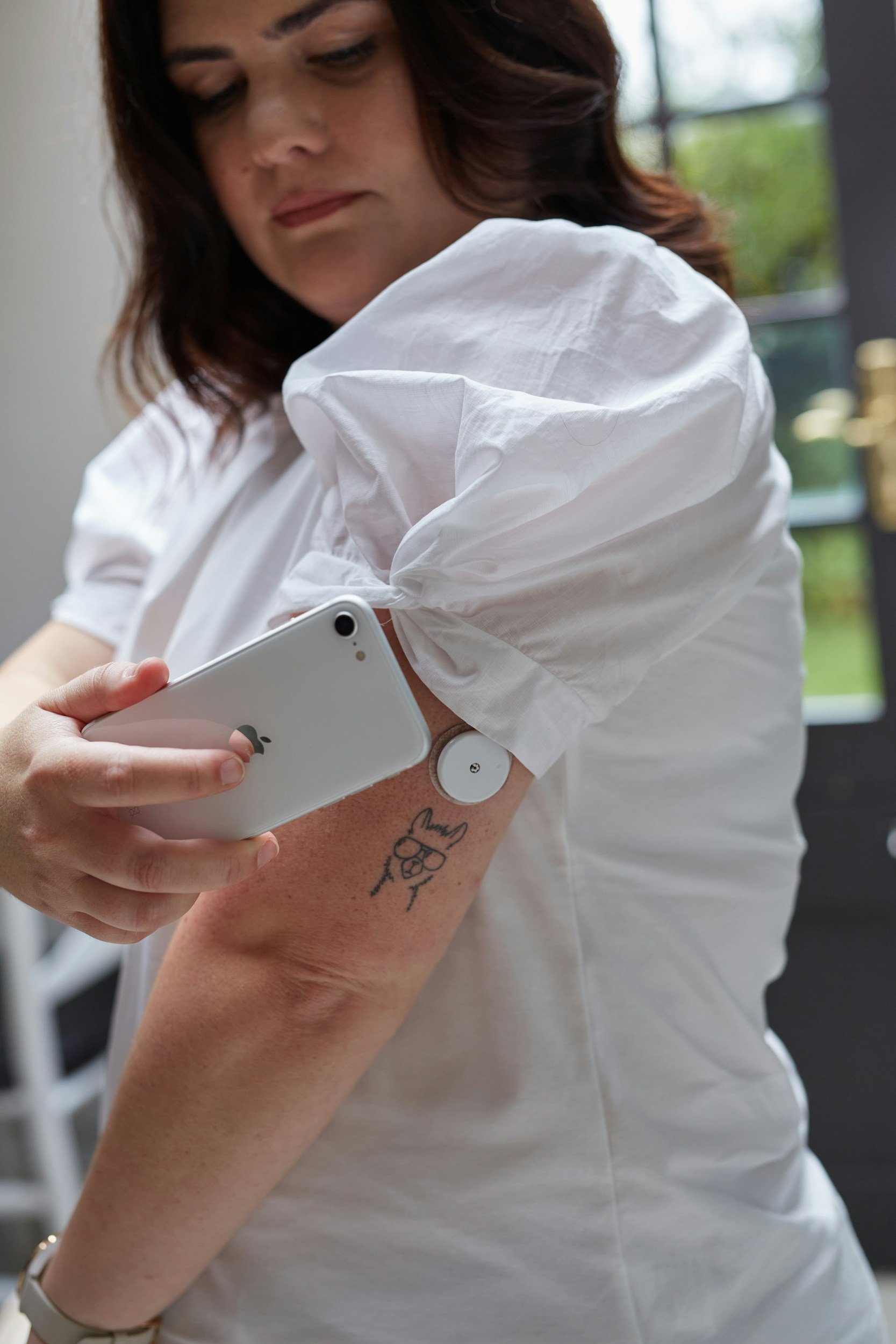
A continuous glucose monitor is a small sensor, usually worn on the back of the upper arm, with a tiny filament sitting just under the skin. It measures glucose in the interstitial fluid (the liquid between your cells, not your blood directly) every few minutes, day and night, and sends the data to your phone. Unlike a standard blood test that gives you a single snapshot at one moment in time, a CGM gives you a continuous readout: how your glucose responds to meals, to exercise, to stress, to sleep. Data stream you can compare day to day, minute to minute.
For people with diabetes, this technology has been genuinely transformative. Before CGMs, managing blood sugar meant finger pricks several times a day. Now, you can catch dangerous lows before they happen. You can adjust insulin doses in real time. The first CGM received FDA approval in 1999, and since then the evidence for their benefit in diabetes management has only grown stronger.
For the rest of us, this is where things get interesting. In 2024, the FDA approved the first over-the-counter CGM for people without diabetes. In Europe, similar devices have been available without prescription for several years, including in Switzerland. Suddenly, anyone can buy one. No doctor's visit needed. And the wellness industry has taken notice. A truly remarkable piece of technology, but why should we care about the current glucose level in our bloodstream?
What is a glucose spike, anyway?
When you eat something containing carbohydrates, your blood glucose rises. This is normal physiology. Your pancreas releases insulin, your cells take up the glucose, and your blood sugar comes back down. The whole cycle takes roughly two hours. A "spike" is simply the peak of that curve.
There are a few diagnostic methods for monitoring your blood sugar levels, and here is what normal looks like. The most standard test you will encounter is the Fasting Plasma Glucose test (FPG, or Fasting Blood Sugar, FBS): you either prick your finger at home or have blood drawn from a vein at the doctor's office after an overnight fast. Normal fasting glucose sits between 70 and 100 mg/dL (3.9 to 5.6 mmol/L). Above 100 but below 126 is considered prediabetes, and above 126 mg/dL is diabetes. Then there is glycated hemoglobin (HbA1c, or A1C), which reflects your average blood sugar over the past two to three months by measuring how much glucose has attached itself to your hemoglobin. Below 5.7% is normal. Between 5.7 and 6.4% is prediabetes.
After a meal, glucose can rise to around 140 mg/dL in a healthy person and should return to baseline within two hours. A large multicenter study that put CGMs on 153 healthy, non-diabetic people found that they spent 96% of their day in the 70 to 140 mg/dL range [1]. The median time spent above 140 was just 2.1%, about 30 minutes per day. That is what a healthy glucose profile actually looks like.
One important point that often gets lost in conversation is that glucose variability does not come only from food. Your blood sugar responds to stress, to waking up in the morning (the dawn phenomenon), to exercise, to sleep quality, and possibly to your menstrual cycle. A single night of poor sleep can induce measurable insulin resistance the next day in healthy people [2]. This means your body responds less to insulin and the glucose level stays higher for longer. Exercise improves insulin sensitivity (greater response) for up to 48 hours afterward [3]. Some studies suggest glucose metabolism deteriorates during the luteal phase of the menstrual cycle [4], though others have found no significant effect [5]. An unexpected result might not mean prediabetes, it might be the terrible night of sleep you had, or the stressful meeting you just walked out of.
So what does a CGM actually give you that a standard blood test does not? The device displays glucose variability in real time, showing you how high the peaks go, how low the troughs dip, and how quickly your blood sugar returns to baseline. The question is whether those nuances matter for a healthy person.
What the science says (and what it doesn't)
A scoping review published in 2025 in Clinical Medicine Insights: Endocrinology and Diabetes asked exactly this question: do glucose spikes affect the health of people without diabetes? [6]. The authors compared the peer-reviewed medical literature with the grey literature (including blogs, wellness sites, social media content). Both agreed that glucose spikes can cause endothelial dysfunction, oxidative stress, and inflammation. However, the grey literature reported additional effects on cancer risk, mental health, energy, mood, and sleep that the medical literature simply does not support. The authors concluded that significant health outcomes likely stem from long-term frequent spikes rather than isolated acute ones.
In other words: if you are a healthy person whose blood glucose level occasionally spikes to 150 mg/dL after a bowl of pasta, the published evidence does not suggest you are damaging yourself. If you are chronically spiking to 180+ multiple times a day for years, that is a different conversation, and probably one you should be having with your doctor.
It is also worth noting that CGMs may not be as precise as they appear. A 2025 study from the University of Bath found that CGMs systematically overestimate glucose in healthy people, with post-meal readings approximately 16 mg/dL higher than capillary blood and time above 140 mg/dL overestimated roughly fourfold [7]. A separate study from Mass General Brigham found no meaningful association between standard CGM metrics and HbA1c in people with prediabetes and normal glucose levels [8]. So that terrifying spike you saw after your smoothie? It might not have been as dramatic as your app suggested.
How can high glucose actually harm us?
If you spend any time in the wellness space, you will have encountered the idea that glucose is slowly "cooking" us from the inside through the process called glycation. Influencers frame it as if every spike is a step toward accelerated aging. The reality is more nuanced, and understanding the actual mechanism helps separate what matters from what does not.
Want to keep reading?
The full article of Joanna Czarnecka-Herok, PhD is available exclusively inside the Seven Springs members app.
Continue exploring evidence-based longevity, practical health strategies and expert insights designed to help you make better decisions for your long-term health.
About the Author Dr. Joanna Czarnecka-Herok, PhD

Dr. Joanna Czarnecka-Herok brings a deeply scientific perspective to longevity.
With a background in cellular and molecular biology, her work focuses on some of the most important mechanisms behind ageing, including cellular senescence, the process by which cells stop dividing and begin to influence surrounding tissue and biological function. She completed her PhD research on cellular senescence in cancer therapy at the Nencki Institute of Experimental Biology, Polish Academy of Sciences, followed by postdoctoral work at the Cancer Research Center of Lyon, a joint Inserm and CNRS research institute in France, exploring the role of elastin in cellular ageing. Her scientific career includes peer-reviewed publications and presentations at international conferences, reflecting her strong foundation in research and evidence-based thinking.
Today, Dr. Czarnecka-Herok works at the intersection of science, longevity, ageing biology and health technology. Through science communication, she translates complex research into clear, evidence-based content for both professional and general audiences.
At Seven Springs, Dr. Czarnecka-Herok contributes her expertise in the biology of ageing, health technology and evidence-based longevity, helping us bring scientific clarity into a field that is often difficult to navigate.